AI Image Generators for Brand Design Benchmark: Midjourney vs Ideogram vs GPT Images (2026)
A research-based benchmark comparing Midjourney, Ideogram, and OpenAI GPT Images for brand design. Evaluates style reference fidelity (SREF), in-image typography precision, prompt-free visual workflows, and multi-model routing.
Establishing a cohesive brand visual identity has historically demanded rigorous art direction: calibrated color books, meticulous lighting setups, custom typography guidelines, and exhaustive photoshoot coordination. When generative AI entered commercial creative workflows, early adopters attempted to recreate this cohesion through sprawling, paragraph-long text prompts packed with modifiers like “photorealistic, cinematic 8k, volumetric lighting, octane render.”
In practice, excessive text prompting introduced severe inconsistencies: aesthetic drift across aspect ratios, unpredictable color bleeding, and garbled brand typography.
By October 2026, the industry reached a decisive consensus: scalable brand design in generative AI requires visual-first workflows and multi-model routing. Instead of wrestling with verbose text prompts, creative directors now anchor visual systems using style references, algorithmic personalization codes, and model-specific task routing.
This benchmark provides a research-based comparison of the three leading generative image platforms for brand design: Midjourney, Ideogram, and OpenAI GPT Images (encompassing DALL-E 3 and GPT-4o multimodal generation). We examine their style consistency pipelines, typographic rendering fidelity, multi-model production workflows, and architectural boundaries based on vendor specifications and official documentation reviewed in October 2026.
How this comparison was made
- This is a research-based comparison, not a lab test. We did not run synthetic prompt bake-offs or subjective beauty pageants. We evaluate architectural mechanics, published feature sets, and official system constraints.
- Every factual claim comes directly from official product documentation, release notes, and developer guides published by [Midjourney](https://midjourney.com), [Ideogram](https://ideogram.ai), and [OpenAI](https://openai.com) as read in October 2026. Where a vendor does not state an architectural parameter or feature limit, we write "not stated".
- We do not publish prices. Subscription tiers, GPU fast hours, concurrent job limits, and credit packages change frequently and differ across international regions. Each section provides direct links to the vendors' official pricing pages so you can review current terms directly.
Quick answers
Which tool fits which design priority
- Cinematic art direction and texture: Midjourney is the premier platform for high-fashion editorial imagery, complex material physics, cinematic lighting, and consistent aesthetic style transfer using SREF vectors.
- Brand typography and graphic layouts: Ideogram leads the industry in generating crisp, legible text, vector-style logo concepts, marketing banners, and packaging mockups with complex typographic hierarchy.
- Conversational composition and fast iteration: OpenAI GPT Images excels at multi-turn natural language dialogue, semantic spatial reasoning, and intuitive inpainting adjustments directly inside ChatGPT.
- Production multi-model routing: Modern creative agencies rarely choose just one. They route initial concepting and editorial backdrops to Midjourney, typographic packaging to Ideogram, and localized conversational touch-ups to GPT Images.
Critical brand consistency trade-offs
- Prompt vs Reference friction: Over-prompting in Midjourney degrades style fidelity; the model performs best when text is stripped to bare nouns and guided by visual references (`--sref`) or camera shorthand.
- Typography vs Aesthetic trade-off: Ideogram renders near-perfect typography but historically exhibits slightly less nuanced photographic micro-textures compared to Midjourney's photorealism engine.
- Canvas manipulation limits: OpenAI GPT Images offers conversational inpainting but lacks granular command-line parameter flags (such as style weight `--sw` or aspect ratio locks) available in Midjourney.
1. Visual Style Consistency: The “Prompt-Free” Shift
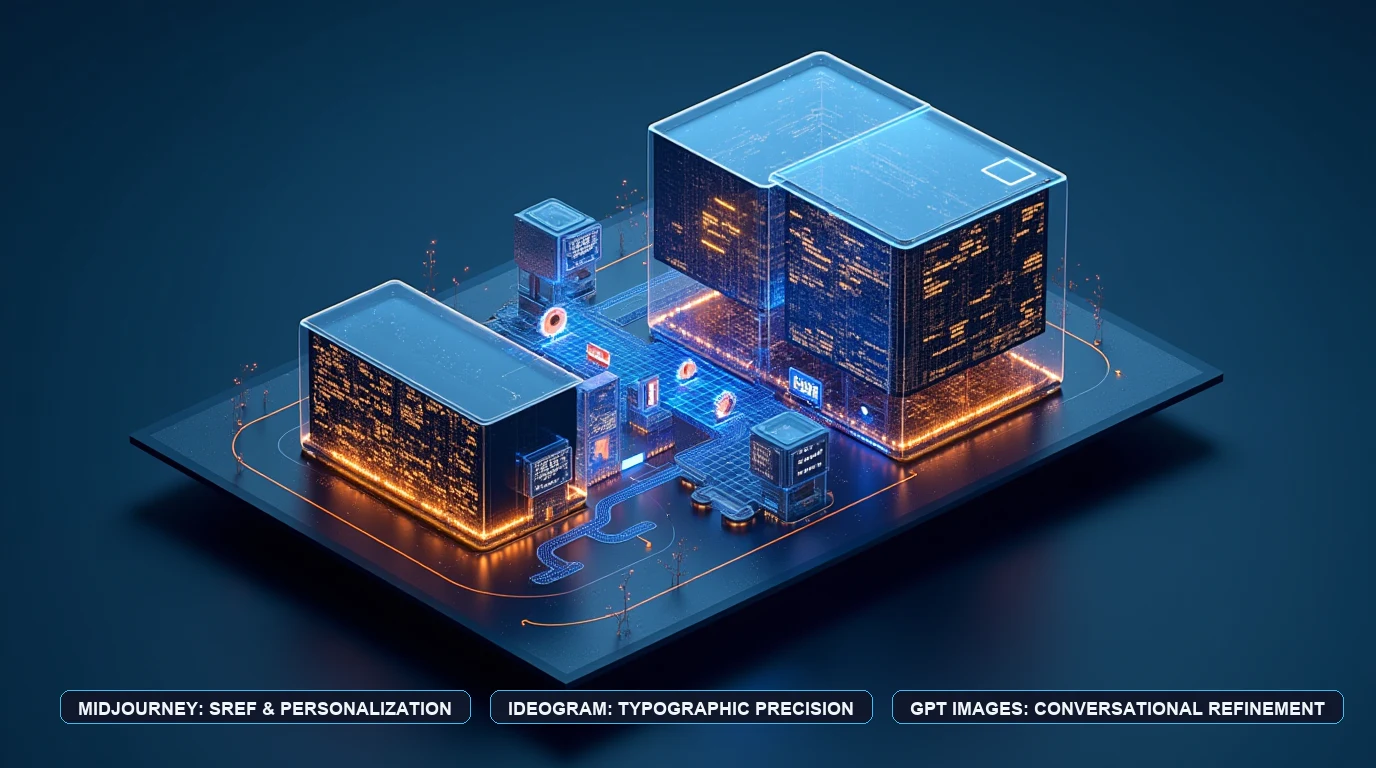
The foundational obstacle in applying generative AI to commercial branding has always been visual variance. In a traditional advertising campaign, every asset—from Instagram carousels to billboard hero shots—must share an identical color grading, film grain, depth of field, and lighting language.
The Problem with Long Text Prompting
In early generative workflows, creators attempted to enforce consistency through exhaustive prompt engineering. However, research into latent diffusion architectures demonstrates that long prompts create severe internal competition:
- Token Attention Dilution: As token count increases, the transformer cross-attention layers distribute attention weights across dozens of words, reducing the impact of primary subject nouns.
- Style Bleed & Cliché Traps: Generic descriptors like “award-winning” or “masterpiece” bias the diffusion model toward over-saturated, hyper-glossy stock photography archetypes.
- Subtractive Correction Failure: When an image generates an unwanted tint (for instance, an aggressive green hue), adding “no green” or “neutral lighting” to the text prompt often exacerbates the issue because the model’s attention mechanism activates on the token “green”.
Midjourney’s Visual Reference Architecture
Midjourney solved this bottleneck by decoupling subject description from aesthetic direction:
- Style References (
--sref): Users supply one or more image URLs. Midjourney extracts the visual embedding (color palette, contrast curve, lens blur, lighting geometry) and applies it to the new subject without transferring the source image’s geometry. The relative strength is calibrated via the style weight parameter (--sw 0to--sw 1000). - Character References (
--cref): Enables consistent human subjects across diverse campaign settings, matching facial features and body proportions while altering attire, pose, and background. - Personalization Profiles (
--p): By rating hundreds of image pairs, creative directors train an individualized model profile code that permanently encodes their studio’s aesthetic preference. - Camera and Publication Shorthand: Rather than describing three-point lighting, referencing recognized cultural anchors (“shot on 35mm Leica M6”, “Dazed editorial lighting”) communicates an entire lighting and optical profile in two words.
OpenAI GPT Images: Conversational Semantic Anchoring
OpenAI approaches style consistency through conversational memory and multimodal context:
- Inside ChatGPT, GPT-4o analyzes previous visual outputs in the chat thread, maintaining awareness of compositional intent.
- When requesting modifications, users provide conversational directives (“keep the same model and pastel background, but change the prop to a coffee cup”).
- While intuitive for non-technical users, it lacks explicit mathematical weight sliders (
--sw) or reusable style hash codes, making absolute enterprise-wide aesthetic locking harder to automate across teams.
2. In-Image Typography & Graphic Layout Precision
The second critical hurdle for brand design is typography. Packaging mockups, social media promotions, posters, and editorial layouts require accurate, perfectly spelled text rendered directly in the visual hierarchy.
Ideogram: Architectural Specialization in Lettering
Ideogram established its market position by solving the notorious “AI gibberish text” failure mode:
- Typographic Accuracy: Ideogram (v2 and v2.5) demonstrates industry-leading character precision. Text placed inside quotation marks in the prompt is rendered cleanly without missing ligatures, warped serifs, or phantom letters.
- Graphic Design Modes: Ideogram provides dedicated rendering styles (
Design,Typography,General,Realistic). TheDesignmode optimizes for flat graphics, vector aesthetics, screen-printing styles, and poster layouts with balanced negative space. - Color Palette Control: Users can specify exact hex color palettes or select predefined brand harmonies, ensuring that generated graphics adhere strictly to brand design tokens.
Midjourney and GPT Images Typography Benchmarks
- Midjourney (v6.1 / v7): Midjourney introduced text generation in v6, capable of short titles, t-shirt slogans, and packaging labels in quotation marks. However, complex multi-line sentences, small-print legibility, and intricate typographical hierarchy still exhibit occasional character merging or misspelling.
- OpenAI GPT Images (DALL-E 3): Capable of rendering short, distinct words on signs, labels, and book covers. However, text density is constrained; attempting to render multi-paragraph posters or detailed packaging nutrition labels frequently degrades into pseudo-lettering.
3. Multi-Model Routing Strategy & Workflow Decision Matrix
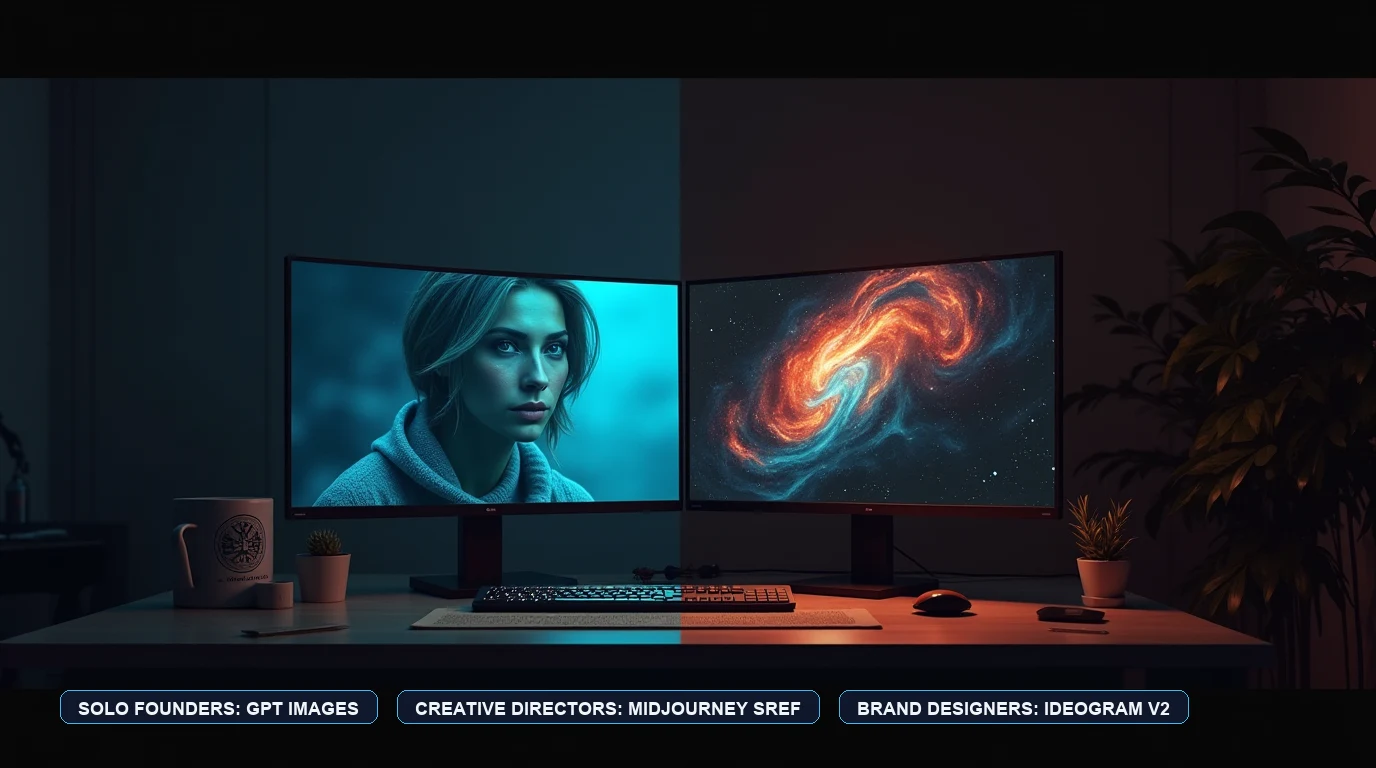
High-velocity creative agencies and brand design teams no longer rely on a monolithic tool. They implement multi-model routing pipelines, deploying each engine where its neural weights exhibit maximum competence.
The 3-Tier Production Pipeline
- Tier 1 — Aesthetic Foundations (Midjourney): Art directors establish the visual world. Using mood boards converted into
--srefvectors and camera references, they generate hero photographic textures, character plates, and atmospheric lighting backdrops. - Tier 2 — Typographic & Brand Assets (Ideogram): Marketing designers generate packaging mockups, apparel prints, poster headlines, and geometric brand badges where typography must be flawless.
- Tier 3 — Conversational Inpainting & Handoff (GPT Images / Retouching): Specific elements (swapping a hand-held product, adjusting a facial expression, or cleaning an edge) are handled via targeted inpainting and raster retouching tools before packaging into production design tokens.
| Evaluation Dimension | Midjourney (v6.1 / v7) | Ideogram (v2 / v2.5) | OpenAI GPT Images (DALL-E 3 / GPT-4o) |
|---|---|---|---|
| Primary Strength | Photorealistic textures, editorial art direction, lighting | In-image typography, poster layouts, graphic design | Conversational reasoning, semantic prompt adherence |
| Style Consistency Engine | Style References (--sref), Personalization (--p) | Style Reference tags, predefined design modes | Conversational thread context, reference upload |
| Character Consistency | Dedicated Character Reference (--cref) | Image weight reference (--iw) | Natural language description in thread |
| Typography Accuracy | Moderate (short words, single labels) | Industry-leading (complex phrases, multi-line) | Moderate (short slogans, signboards) |
| Interface & Access | Web alpha canvas, Discord bot, API (third-party) | Native Web application, official REST API | ChatGPT web/mobile interface, OpenAI API |
| Canvas & Inpainting | Vary (Region), Pan, Zoom, Inpaint canvas | Canvas editor, Magic Fill (inpaint), extend | Inpainting brush inside ChatGPT, API mask endpoint |
| Pricing Model | Subscription tiers (Basic, Standard, Pro, Mega) | Free tier + Subscription tiers (Basic, Plus, Pro) | ChatGPT Plus/Team/Enterprise or pay-per-token API |
4. Feature-by-Feature Comparison
Style Reference Fidelity & Control
- Midjourney: Unmatched parameter precision. By adjusting
--sw(style weight), creative leads can dial in whether a reference image dictates 10% or 90% of the output’s mood. Furthermore, multiple style references can be weighted simultaneously (--sref url1::2 url2::1), allowing designers to blend two distinct visual aesthetics mathematically. - Ideogram: Features visual style references and palette constraints, excelling when creating graphic vector sets, icon collections, and sticker sheets with uniform line weight.
- OpenAI GPT Images: Relies on multimodal prompt injection. You can attach an image to ChatGPT and instruct the model to “match this visual style,” but the engine does not provide numerical weighting coefficients.
Typographic Layout & Logo Ideation
- Ideogram: The undisputed winner for branding collaterals requiring typography. Whether generating coffee shop storefront signage, retro packaging labels, or event posters, Ideogram positions letterforms cleanly along perspective grids.
- Midjourney: Excels at artistic logos (embossed seals, gold leaf monograms, 3D chrome emblems) where text is decorative rather than informational. When exact brand spelling is required, designers often generate the background in Midjourney and composite typography in vector software.
- OpenAI GPT Images: Reliable for conceptual ideation and symbolic logos, but prone to stylistic homogenization if prompts are not heavily constrained.
Multi-Turn Refinement & Editing Workflow
- OpenAI GPT Images: Highest conversational dexterity. If a background element is misaligned, simply telling the assistant “remove the tree on the left and brighten the foreground” produces immediate modifications while preserving the overall scene geometry.
- Midjourney: Editing is managed via web canvas tools:
Vary (Region)for localized inpainting, directional pan arrows, and outpainting zoom (Zoom 1.5x,Zoom 2x). It demands a more structured, methodical operator workflow. - Ideogram: Offers a spatial canvas interface with
Magic Fillfor inpainting and infinite canvas expansion, bridging the gap between raw text generation and graphic layout tools.
Which one fits your team?
Use this decision framework to match your organization’s creative priorities:
- If you are an art director producing fashion, luxury, or cinematic brand campaigns: Choose Midjourney. Its rendering of micro-surface textures, skin realism, volumetric lighting, and fine-tuned
--srefstyle vectors remains the benchmark for editorial imagery. - If your team designs apparel, packaging, event posters, and typography-heavy marketing assets: Choose Ideogram. You will eliminate hours of post-generation Photoshop retouching previously wasted on fixing scrambled AI text.
- If you are a solo founder, product manager, or content marketer needing rapid concept ideation: Choose OpenAI GPT Images inside ChatGPT. The natural language interface and conversational inpainting allow rapid iteration without memorizing command-line parameters.
- If you operate a commercial design agency managing scalable client brands: Deploy Multi-Model Routing. Establish mood boards in Midjourney (
--sref), construct marketing collateral in Ideogram, and execute localized touch-ups in raster vector editors.
Disclosure
UtilRank is an independent research publication. We maintain strict editorial independence and evaluate software tools based exclusively on verified technical documentation, vendor whitepapers, and verifiable product capabilities. To learn more about our methodology and affiliate practices, see our editorial disclosure.
Sources and verification
Every technical capability, parameter flag, and architectural workflow in this guide was sourced directly from official vendor documentation and release materials read in October 2026:
- Midjourney, Inc.:
- Midjourney User Guide: Style Reference (
--sref) and Character Reference (--cref) Documentation: midjourney.com - Midjourney Personalization Codes (
--p) and Parameter List: midjourney.com - Midjourney Subscription Plans and GPU Fast Hours: midjourney.com
- Midjourney User Guide: Style Reference (
- Ideogram, Inc.:
- Ideogram v2 & v2.5 Architecture Overview and Typographic Benchmarks: ideogram.ai
- Ideogram Canvas, Magic Fill Inpainting, and Color Palette Specifications: ideogram.ai
- Ideogram Pricing Tiers and Priority Queue Documentation: ideogram.ai
- OpenAI, Inc.:
- DALL-E 3 & GPT-4o Image Generation Capabilities and Safety System Cards: openai.com
- OpenAI Platform API Image Generation Endpoints and Inpainting Guides: openai.com
- OpenAI Pricing and Usage Tiers: openai.com
Looking for in-depth evaluations of the tools mentioned in this guide? Check out our hands-on reviews: